We just crossed 170 subscribers — so this week I'm opening the books completely. Every AI training contract I'm running right now, across two platforms, current and past, with the real pay attached.
I'm running 8 AI training contracts across 2 platforms right now — 6 active, 2 already ended. The pay ranges from $17/hr to $140/task, and none of it required more than one application per platform to get started.
🎙️ Nova's Signal
Nova is FOWL AI's news anchor — she tracks the signals every week.
"Nobody talks about the boring part of this work — that it's a portfolio, not a job. Contracts start, they run for a few weeks or months, and then they end. That's not a red flag. That's just what this labor market looks like right now."
Nova's call: Bullish. Multiple concurrent contracts across platforms is becoming the default way people do this work, not the exception.
Last week we crossed 170 subscribers. Thank you for helping build one of the fastest-growing newsletters focused on AI careers and the future of work. This week's issue is the most literal one I've written: I'm just going to show you what's actually on my plate.
Right now I have contracts open on two platforms — Handshake and Mercor — and they don't work the same way. Handshake has me mid-onboarding on three separate projects and ready to start a fourth. Mercor has two contracts running today and two that already wrapped.
What you'll get from this issue: the full list, the pay attached to each one, and the difference between a contract that's active and one that's ended — because that distinction matters more than it sounds like it should.
This Week — The Full Breakdown
01
Handshake: 4 projects, mixed pay structures
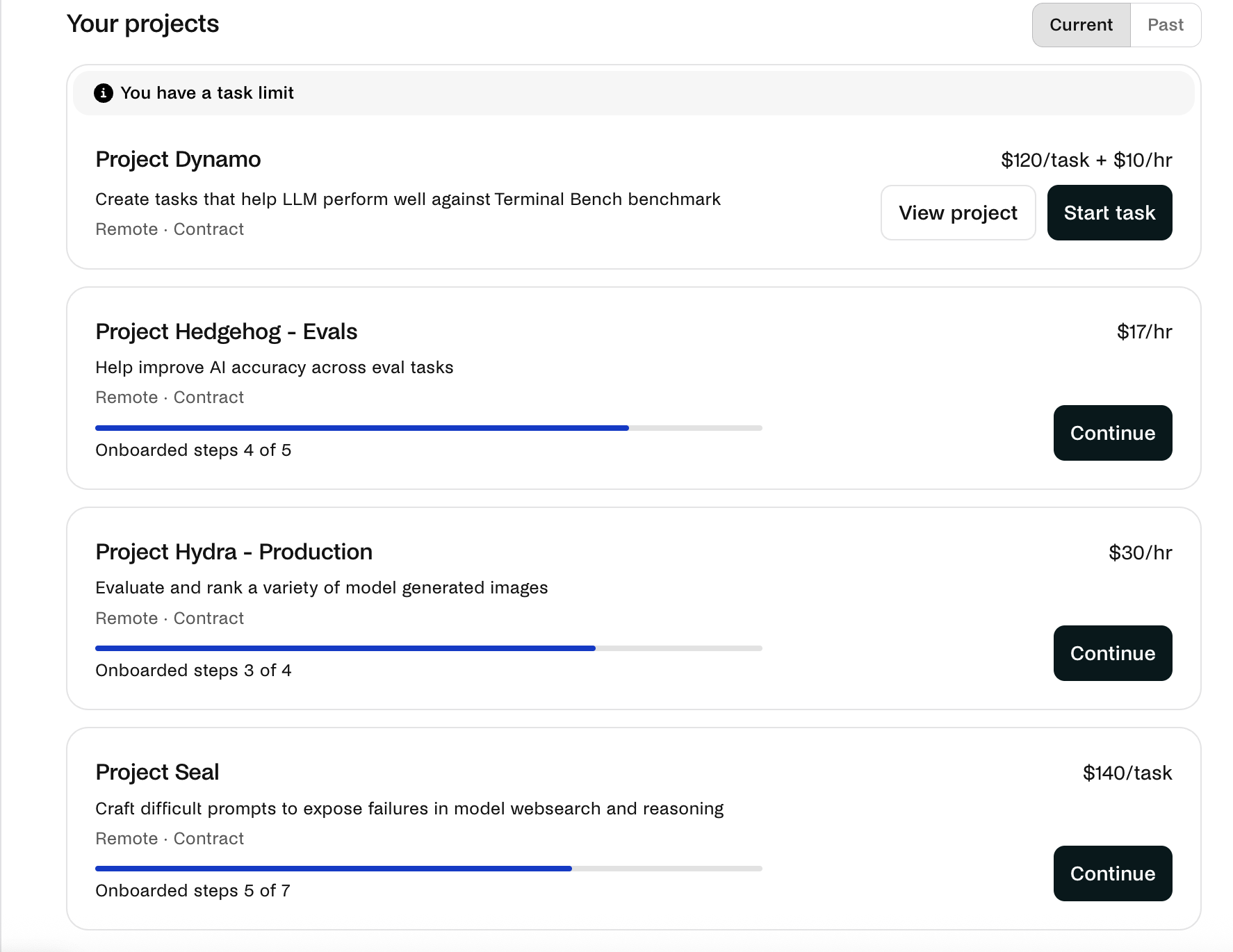
Handshake — yes, the platform best known for college recruiting — is where four of my contracts live. Project Dynamo pays $120/task plus $10/hr and has me building tasks against the Terminal Bench benchmark. Hedgehog-Evals pays a flat $17/hr for accuracy checks across eval tasks, and I'm four steps into a five-step onboarding. Hydra-Production pays $30/hr to evaluate and rank model-generated images, three steps into four. Project Seal is the highest-paying of the four at $140/task, for writing prompts difficult enough to expose failures in model websearch and reasoning — I'm five steps into seven there.
Every one of these came with a task-limit warning at the top of the dashboard. That's not a bug — it's a real constraint on how much of this work you can take on at once, and it's worth knowing before you assume you can stack unlimited contracts.
My actual Handshake project board, screenshotted today.
Why it matters · One platform, four live contracts, three different pay models — this is what "AI training work" actually looks like day to day, not a single job description.
The signal — Per-task pay tends to show up on harder, more adversarial work (Seal, Dynamo); flat hourly shows up on more repetitive eval work (Hedgehog, Hydra). The rate tracks the difficulty, not the platform.
02
Mercor: 2 active, 2 already ended
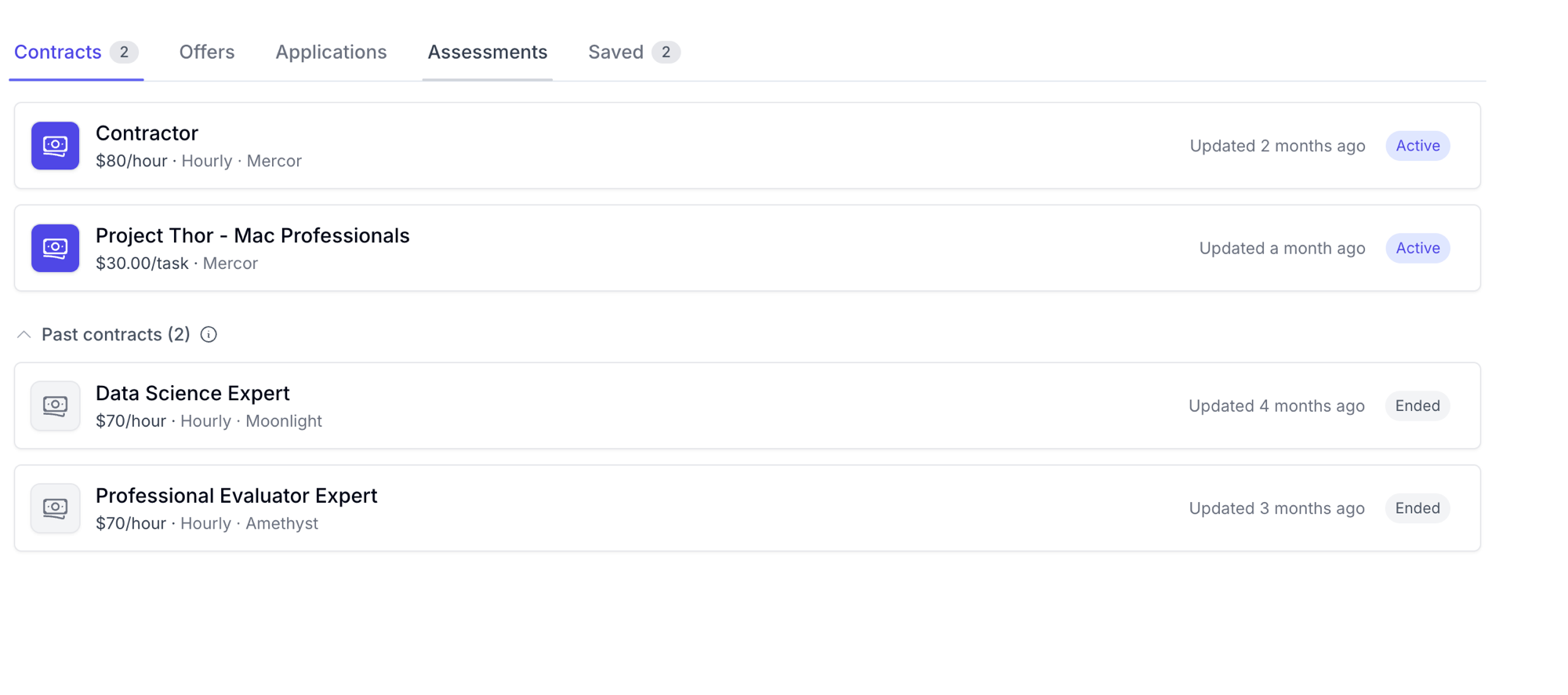
Mercor is where the other four contracts are, and it's the clearest example of the current-vs-past split. Active right now: Contractor at $80/hr and Project Thor - Mac Professionals at $30/task. Both show up as "Active" with no end date attached.
Then there's the past section — two contracts that already ran their course. Data Science Expert paid $70/hr and ended about four months ago. Professional Evaluator Expert also paid $70/hr and ended about three months ago. Both are labeled "Ended," not paused, not failed — just complete.
My actual Mercor contracts tab — 2 active, 2 ended.
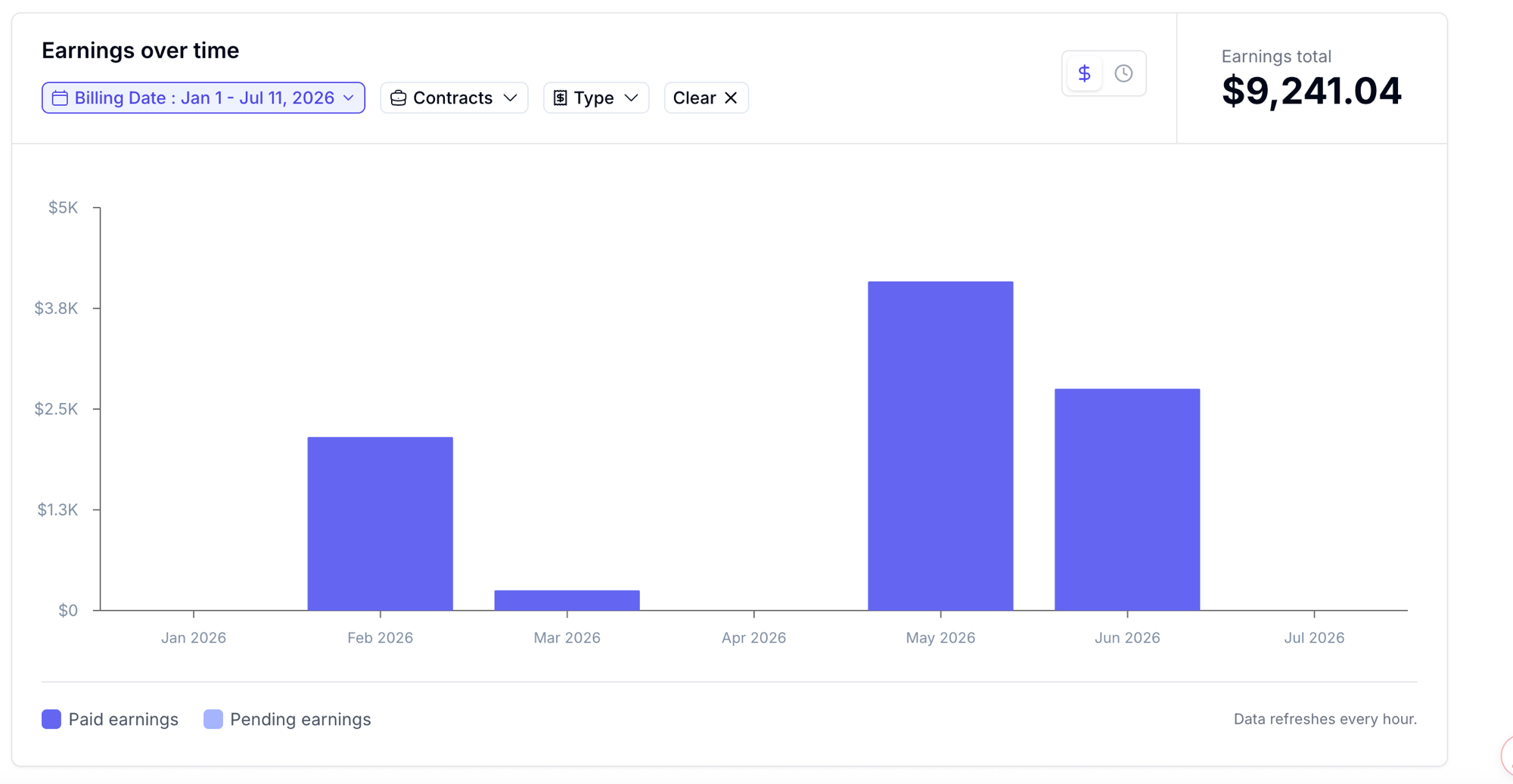
Here's what those four contracts have paid out on Mercor alone: $9,241.04 year to date, across roughly 110 hours — a blended average of about $84/hr. It hasn't come in evenly. Nothing in January, a slow ramp through February and March, a dead April, then the two biggest months yet in May and June.
My actual Mercor earnings chart, Jan 1 – Jul 11, 2026.
Why it matters · Half of my Mercor history is already in the past tense. That's the first real data point I have on how long a typical contract actually lasts.
The signal — Two ended contracts in the same window I've had two new ones start. The portfolio isn't shrinking — it's turning over. And the income doesn't arrive on a flat line — it comes in waves as contracts start, ramp, and close.
03
Current vs. past — why the distinction matters
It's tempting to read "Ended" as a downgrade. It isn't. Data Science Expert and Professional Evaluator Expert both ran for a defined stretch, paid consistently the whole time, and closed out cleanly. Nothing about either listing suggests I did anything wrong or that the platform cut me off.
Meanwhile, six contracts are active today across the two platforms — four still mid-onboarding on Handshake, two running on Mercor. That's the actual shape of this work: a rolling mix of contracts in progress, contracts wrapping up, and new ones opening.
Why it matters · If you're evaluating whether this kind of work is stable, the right question isn't "did a contract end" — it's "did another one replace it."
The signal — Treat "ended" contracts as portfolio turnover, not attrition. The number to watch is how many are active at any given time, not whether any individual one closes.
04
What running 8 contracts actually costs you
The part nobody puts in the pitch: managing eight contracts across two dashboards takes real overhead. Onboarding steps on Handshake alone add up — 4 of 5 on one project, 3 of 4 on another, 5 of 7 on a third. Each platform has its own task-limit rules, its own progress bar, its own login.
None of this is a complaint. It's a logistics problem, not a difficulty problem — and it's exactly the kind of thing that doesn't show up until you're actually in it.
Why it matters · If you're planning to run more than one platform at once, budget time for the coordination, not just the task work.
The signal — The task-limit banner showing up on every Handshake project is a quiet reminder that these platforms are actively managing supply. Availability isn't unlimited on either side.
The spread is wide, but it's not random — the highest-paying work is also the most adversarial or highest-context (writing prompts to break models, benchmark task design). The lowest-paying work is the most repeatable (accuracy checks, image ranking).
Why it matters · If you're choosing where to spend limited hours, difficulty and pay track each other closely enough to use as a filter.
The signal — Don't judge a platform by its lowest listed rate — judge it by its highest, since that's usually where the real skill-based pay shows up.
📡 Signal & Chatter
What the data and community are saying this week.
›
170 subscribers, up from a standing start. Growth has been word-of-mouth and reply-driven so far — no paid promotion behind any of it.
›
Task limits are showing up everywhere. Every open Handshake project in this issue carried a "you have a task limit" banner — a sign these platforms are throttling supply, not just demand.
›
Onboarding is multi-step by design. Three of four Handshake projects required 4-7 onboarding steps before task work even starts — this isn't a same-day sign-up-to-paid pipeline.
›
Ended contracts aren't rare. Half of my Mercor history is already closed out — worth expecting if you're planning around this as steady income.
🔮 FOWL Prediction #8
"By Issue 15 (mid-September), I'll have cycled through at least 12 total contracts across platforms — with the active count holding steady between 4 and 6 at any given time."
The pattern so far: contracts end roughly as often as new ones open. If that rate holds, the total will climb even as the active count stays flat. We'll score this when Issue 15 goes out.
FOWL AI · July 13, 2026 · We'll score this in September 2026.
✅ 3 Things to Do This Week
One for each type of reader — pick yours
01
If you haven't applied to any platform yet — pick one, not two. Handshake and Mercor both take real onboarding time; starting on both at once is how the task-limit walls in story 04 catch you off guard.
02
If you're already on one platform — check whether a second one is worth adding. The pay spread in story 05 shows the real money is in higher-difficulty, per-task work — that might already exist on your current platform before you go looking for a second one.
03
If a contract of yours just ended — don't read it as a signal to stop. Use the gap to apply to what's next while you have the bandwidth, the same way two new contracts opened for me right around when two others closed.
🚀 From the Lab
Sponsored by FOWL AI
Launch Lab — Building something?
We're not an agency — we don't build it for you. Brand Brain is the AI workspace you use to turn what you know into a website, newsletter, and digital products you actually own. You stay in control of it the whole way.
Half the contracts in this issue fall under some version of this title — Hedgehog-Evals, Hydra-Production's ranking work, Professional Evaluator Expert. The job is judgment, not generation: looking at model output and deciding if it's right, ranked correctly, or good enough to ship.
It doesn't require an ML background. It requires the ability to hold a rubric consistently across hundreds of judgments and explain, in writing, why one output beats another. Companies are hiring for this across image ranking, accuracy checks, and reasoning review — the specifics vary, the underlying skill doesn't.
How to position for this now: If you have any background where you've had to grade, review, or QA other people's work — teaching, editing, code review, quality assurance — lead with that on your application. It's a more direct match than most people assume.
The honest version of "get paid to train AI" isn't one contract, it's a portfolio — some active, some just wrapping up, a couple always somewhere in onboarding. That's not instability. It's what this actually looks like once you're a few months in.
So what do you actually do with this on Monday? Pick one platform and apply — don't split your first application across two. If you're already in, check whether a higher-paying, harder project is sitting in your dashboard right now instead of the easiest one. And if a contract of yours just ended, use it as a prompt to apply to what's next, not a reason to slow down.
Next issue, I'm stepping back out to cover what's happening across the industry more broadly. But I wanted you to see the unglamorous, literal version first.
"It's not one job. It's a portfolio you keep refilling."
💬 One question — reply and tell us
How many platforms are you currently signed up for — and how many of them have actually turned into paid contract work? Hit reply. We read every one and it shapes what we cover next.